- Contact Us Now: (888) 765-4825 Tap to Call



Can You Revive a Dead Trademark? What Business Owners Need to Know


A dead trademark status just means the application or registration isn’t active at the U.S. Patent and Trademark Office anymore. That’s it. It doesn’t tell you whether the name is actually free to use, and if it’s your own mark that went dead, it doesn’t automatically mean it’s gone for good either. Some dead trademarks can be brought back by their original owner. Others can create real legal headaches for whoever adopts them years later. Knowing the difference before you file, launch, or build a brand around a name can save you a lot of money and a lot of stress.
This guide walks through what “dead” actually means, when a trademark can be revived, when it can’t, and what to check before you build a business around a name someone else let go.
Dead Trademark at a Glance
- Dead application (abandoned): sometimes revivable
- Dead registration (cancelled or expired): usually not revivable
- Petition to Revive deadline: 2 months (up to 6 in limited cases)
- Petition to Revive fee: $250, filed electronically
- Common law trademark rights: can survive a dead federal filing
Can a Dead Trademark Be Revived?
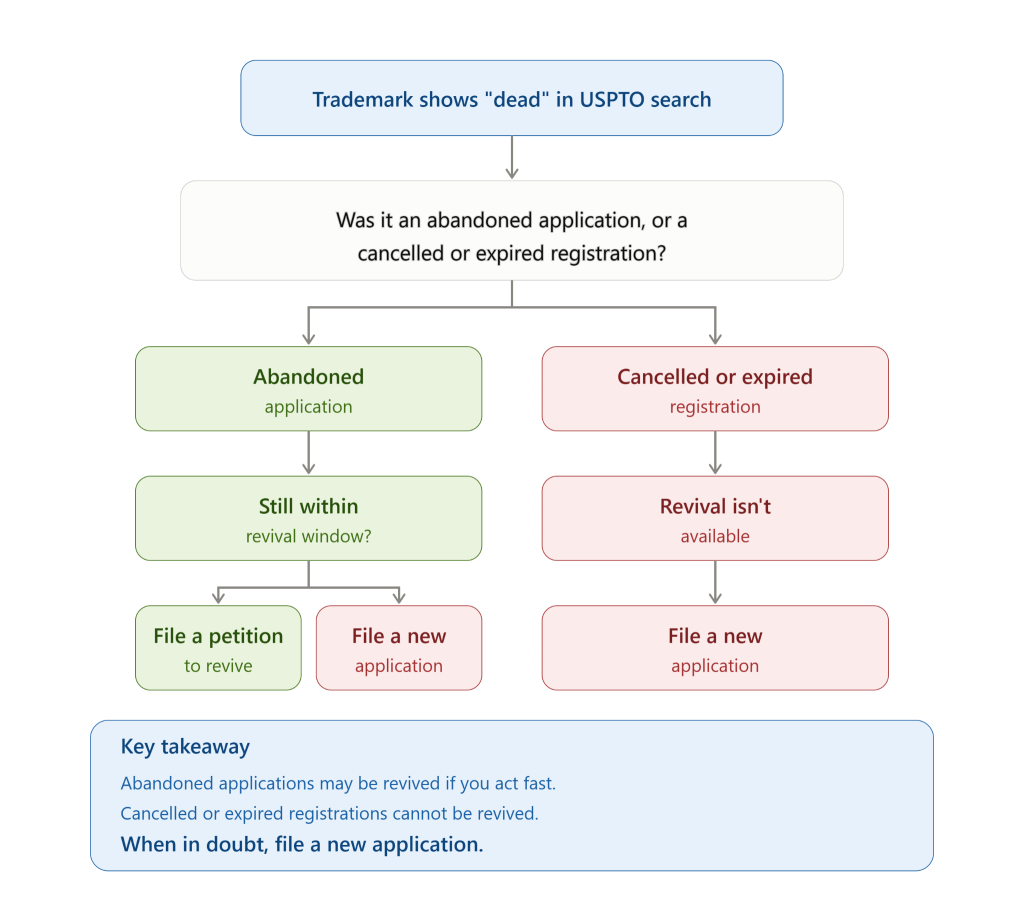
A dead trademark application can sometimes be revived through a Petition to Revive, but only within a strict two-month window and only if the delay was unintentional. A dead trademark registration (cancelled or expired) generally cannot be revived. Instead, you’ll usually need to file a new application. Whether you can freely adopt someone else’s dead mark is a separate question. The answer is usually no, not without checking further, because common law rights and actual marketplace use can survive a dead USPTO record.
Dead Trademark: The Term the USPTO Actually Uses
“Dead” is USPTO shorthand, not a legal category with one set of consequences. When you search the Trademark Status and Document Retrieval (TSDR) database, “Dead/Inactive” can mean any of the following:
- An application that was abandoned before it ever became a registration
- A registration that was cancelled because the owner missed a maintenance filing
- A registration that expired because it wasn’t renewed
- A registration cancelled through a Trademark Trial and Appeal Board (TTAB) proceeding, including the newer expungement and reexamination proceedings created by the Trademark Modernization Act of 2020, which let a third party ask the USPTO to cancel a registration for a mark that was never used, or stopped being used, in commerce
Abandoned Application vs. Dead Registration
| Abandoned Application | Cancelled or Expired Registration | |
| What happened | The mark never finished the registration process | The mark was registered, then lost that status |
| Common cause | Missed an Office Action deadline, missed a Statement of Use deadline | Missed the Section 8 Declaration of Use (years 5–6) or Section 8/9 renewal (year 10) |
| Can it be revived? | Yes, sometimes, through a Petition to Revive | No, in almost every case |
| Deadline to act | 2 months from the Notice of Abandonment | Not applicable, revival isn’t available |
| What to do instead | File the petition, or file a new application | File a new application |
If your mark never made it to registration, revival may genuinely be on the table. If it was registered and then lapsed, a fresh application is the realistic path forward.
Why Trademark Applications and Registrations Go Dead
Most dead marks aren’t the result of anyone deciding to give up a brand. They’re the result of a deadline that got missed while someone was running a business.
USPTO guidance explains that missed filing deadlines, particularly failing to respond to an Office Action or submit a required Statement of Use, are common reasons trademark applications become abandoned
Common causes for an abandoned application:
- Missing the response deadline for an Office Action (typically three months, extendable to six)
- Missing the deadline to file a Statement of Use after a Notice of Allowance
- Missing an extension request deadline for intent-to-use applications
Common causes for a cancelled or expired registration:
- Missing the Section 8 Declaration of Use, due between the fifth and sixth year after registration
- Missing the combined Section 8 and Section 9 renewal, due every ten years
- The business closing, rebranding, or simply losing track of an old mark that’s no longer used
- A successful third-party expungement or reexamination proceeding for non-use
Can You Legally Use a Dead Trademark?
This is the question most people are actually asking when they search for this topic, and it deserves a direct answer instead of the usual hedge.
Yes, sometimes, but a dead USPTO record does not mean the mark is legally free to use. Federal registration is not the only source of trademark rights in the United States. Rights can also arise from actual use of a mark in commerce, known as common law trademark rights, and those rights don’t disappear just because a USPTO filing lapses.
Before adopting a name tied to a dead mark, check for:
- Continued use in the marketplace. Is a business still operating under that name, selling under that name, or marketing under that name, even without an active federal registration?
- State trademark registrations. Some businesses maintain state-level protection even after letting a federal filing lapse.
- Residual goodwill. If the mark was well known, courts have in some cases protected a former owner against confusingly similar use for a period after abandonment, particularly where consumers might still associate the mark with the original business.
- How recently it went dead. A mark that went dead last month carries more risk than one that’s been inactive for a decade with no sign of ongoing use.
- Why it went dead. An abandoned application in the middle of prosecution is a different risk profile than a registration that expired after ten years of genuine, documented non-use.
- How similar is your intended use. Compare the goods, services, and geography you’re planning against the original use. Closer overlap means higher risk.
None of these factors show up as a simple “clear” or “not clear” flag in a USPTO database search. That’s the gap between a database check and an actual clearance opinion, and it’s the single most common misunderstanding we see business owners run into.
Example:
A restaurant owner found a trademark listed as “dead” in the USPTO database and assumed the name was available. After investing in signage, a website, and marketing materials, they discovered the previous owner was still operating locally under the same name and had enforceable common law trademark rights. The business ultimately had to rebrand, a costly mistake that could have been avoided with a proper trademark clearance search.
Dead Status, Revival, and Risk at a Glance
| Situation | Can It Be Revived? | Your Next Step | Risk of Adopting It |
| Abandoned application, still within the deadline | Yes | File a Petition to Revive | Not applicable, it’s your own mark |
| Abandoned application, deadline has passed | No | File a new application | Low to moderate, if you’re the one adopting it |
| Cancelled or expired registration | No | File a new application | Moderate, depends on how recently it lapsed |
| Dead status, but the mark is still visibly in use | No | Investigate before filing or launching | High, common law rights likely still apply |
That last row is the one people miss most often. A mark can show “dead” in the federal database while the business behind it is still very much alive in the marketplace.
How to Revive a Dead Trademark Application
If your own application went dead, here is the process, in order.
Step 1: Confirm you’re eligible
Revival through a Petition to Revive is only available for abandoned applications, and only when the abandonment was caused by missing a deadline unintentionally, not for registrations that were cancelled or expired. Check the application’s status and history in TSDR before doing anything else; if the status codes themselves are confusing, our breakdown of common trademark application statuses explains what each one actually means.
Step 2: Check the deadline
Under 37 C.F.R. § 2.66, you must file the petition:
- Within two months of the issue date on the Notice of Abandonment, or
- If you never received that notice, within two months of learning of the abandonment, and no later than six months after the application’s status changed to abandoned in the USPTO’s records
Miss both windows, and revival is off the table. The USPTO’s own guidance on reviving an abandoned application walks through which petition form applies to which situation. A new application becomes the only route once the deadline has passed.
Step 3: File the correct petition form with the USPTO
The USPTO uses different petition forms depending on why the application went dead, for example, a missed Office Action response versus a missed Statement of Use. Filing the wrong form, or an incomplete one, is a common reason petitions get denied.
Step 4: State that the delay was unintentional
The petition must include a signed statement, from someone with firsthand knowledge, asserting that the failure to respond was unintentional. This is a legal statement made under penalty of perjury-equivalent rules, not a formality to skim past.
Step 5: Complete the missed action
Revival isn’t just paperwork acknowledging the mistake. You also have to actually do the thing you missed: file the overdue response to the Office Action, submit the Statement of Use, or file the extension request, along with the petition.
Step 6: Pay the filing fee
As of the USPTO’s current fee schedule, the petition to revive fee is $250 when filed electronically (higher for paper filings), separate from any Statement of Use or extension fees due at the same time.
Step 7: Respond to any follow-up Office Actions
If the USPTO grants the petition but has additional questions about the underlying filing, respond promptly. A second missed deadline on the same issue generally cannot be revived a second time.
When a New Application Makes More Sense Than Revival
Revival isn’t always the better move, even when it’s technically available.
File a new application instead when:
- The registration was cancelled or expired (revival isn’t an option at all)
- The two- or six-month revival deadline has already passed
- The mark, business, or intended use has changed enough that the old application no longer accurately describes it
- A competing application or registration has been filed in the meantime, which can complicate or block revival of the old one
Pursue revival instead when:
- The window is still open
- The delay was genuinely unintentional and can be documented
- Preserving the original filing date matters, because trademark priority in the U.S. generally runs from the earlier of the application’s filing date or the date use in commerce began
If you’re filing new rather than reviving, start with a real trademark search by class rather than a quick database check, and if the old name itself is the problem, our guide to picking a strong, distinctive trademark name is worth reading before you file.
What We See in Practice
A few patterns come up repeatedly when clients ask about dead trademarks.
Attorney Insight: The best time to evaluate a dead trademark is before you invest in a new brand or miss a USPTO deadline. A brief legal review can often identify issues that are far more expensive to fix after launch.
The most common mistake: A business owner sees a trademark marked “dead” in the USPTO database and assumes the name is available. It isn’t. A dead USPTO status is the start of the analysis, not the end.
The most common misconception: Many people think the USPTO database reflects real-time marketplace use. It doesn’t. A business may still be using a mark and have enforceable common law rights even after its federal registration becomes dead.
Why deadlines get missed: Most missed deadlines result from outdated contact information, missed notices, administrative oversight, or a business owner losing track of an older registration. Once a deadline passes, the clock on revival starts immediately.
What surprises clients most: The revival window is short and unforgiving. Once it closes, filing a new application is usually the only option.
A scenario we see often: Business owners discover a dead registration only after noticing a competitor using a similar name. By then, revival is often unavailable, and the focus shifts to filing a new application and evaluating any remaining common law rights.
The takeaway: A trademark search before adopting a name and regular USPTO status checks for existing registrations are simple steps that help prevent costly mistakes.
Frequently Asked Questions
Does a dead trademark mean the name is free to use?
Not automatically. A dead USPTO status doesn’t erase common law rights or state trademark registrations. Check for continued use before adopting the name.
How long do I have to revive an abandoned trademark application?
Generally, two months from the Notice of Abandonment. If you never received it, you may have up to two months after learning of the abandonment, but no later than six months from the USPTO abandonment date.
Can I revive a cancelled or expired trademark registration?
No. A Petition to Revive applies only to abandoned applications. Cancelled or expired registrations require a new application.
How much does it cost to file a Petition to Revive?
The current USPTO filing fee is $250 when filed electronically, plus any applicable filing fees.
Someone stopped using their trademark. Can I use it?
Not necessarily. Check for continued use, common law rights, and state registrations before adopting the mark.
Do I need a lawyer to file a Petition to Revive?
No, but mistakes can be costly because revival requires the correct filing, supporting statement, and strict deadlines.
Common Mistakes to Avoid
- Treating “dead” as “available.” A database status isn’t a clearance opinion.
- Missing the two-month petition deadline because the Notice of Abandonment went to an old email or mailing address.
- Filing the wrong petition form for the specific reason the application went dead.
- Assuming a cancelled registration can be revived the same way an abandoned application can.
- Skipping a trademark search entirely before adopting a name that once belonged to someone else.
- Not updating correspondence information with the USPTO after a registration issues, which is the single most common reason maintenance deadlines get missed years later.
Key Takeaways
- “Dead” covers different situations. Abandoned applications may be revivable within a strict two-month window; cancelled or expired registrations generally are not.
- A dead trademark isn’t automatically free to use. Common law rights and state registrations can outlive a lapsed federal filing.
- The petition fee is currently $250 electronically, but the real cost of missing the deadline is the mark itself.
- A real trademark search and a conversation with a trademark attorney, on either side of this issue, catch problems while they’re still fixable.
Talk to a Trademark Attorney Before You File or Build
Before you invest in branding, packaging, a website, or a trademark application built around a name that showed up “dead,” make sure you actually know what that status means for your situation. The same goes if it’s your own registration that lapsed: a quick legal review now is a lot cheaper than a rejected petition, a wasted filing, or a dispute you didn’t see coming.
Amanda Rokita and the trademark and intellectual property lawyers at Rokita Law work with business owners across Los Angeles and Orange County on trademark filings, revivals, searches, and disputes. Schedule a consultation today, before a deadline or a name choice becomes harder to fix.
“This article is provided for educational purposes only and does not constitute legal advice or create an attorney-client relationship.