- Contact Us Now: (888) 765-4825 Tap to Call



Your Trademark Was Rejected. Now What?


A USPTO Office Action is not the end — it’s the beginning of a strategy. Here are the five most common reasons for rejection and exactly what to do next.
Rokita Law, P.C. · Trademark & IP · 8 min read
Receiving a USPTO Office Action can feel alarming — especially when you’ve invested time, money, and energy into building your brand. But an office action is not a final rejection. It is an official communication from the USPTO identifying specific issues with your application, and in most cases, those issues can be addressed. You have three months to respond. Here is exactly what you need to know.
01 — Reason One: Likelihood of Confusion

The most common reason for trademark refusal is a likelihood of confusion with an existing registered mark. The USPTO examines whether consumers would likely be confused between your mark and one already on the register — considering similarity in appearance, sound, and meaning, as well as the relatedness of the goods or services each covers.
This does not necessarily mean the marks are identical. A mark that sounds similar, looks similar, or carries similar commercial meaning may still trigger a refusal — particularly when the goods and services overlap.
What to Do: An experienced trademark attorney can craft a substantive legal argument distinguishing your mark from the cited registration. This may include arguing differences in appearance, commercial impression, trade channels, or consumer sophistication. Many applications initially refused on this ground are ultimately approved with a well-reasoned response.
02 — Reason Two: Merely Descriptive Mark
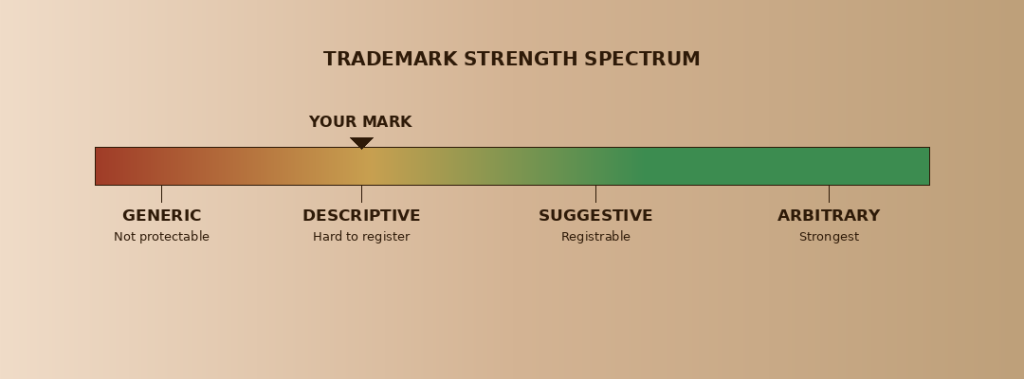
The USPTO will refuse to register a mark that merely describes the goods or services it represents. A mark like “Fresh Squeezed” for orange juice, or “Fast Delivery” for a courier service, provides no source-identifying function — it simply tells consumers what the product is or does.
The law requires marks to be distinctive, not just accurate. The more your mark describes your offering, the weaker it is as a trademark — and the more likely it is to face this refusal.
What to Do: Depending on how long you’ve been using the mark, you may be able to argue it has acquired secondary meaning — meaning consumers now associate it with your brand specifically. Alternatively, your attorney may recommend amending your application to the Supplemental Register, which provides some protections while you build brand recognition over time.
“A trademark rejection is not a verdict. It is an invitation to make a stronger argument.” — Rokita Law, P.C. · Trademark & IP Practice
03 — Reason Three: Primarily Merely a Surname

The USPTO will refuse marks that the public primarily perceives as a surname. Common last names — particularly those that appear frequently in phone directories or carry no other recognized meaning — are considered to lack distinctiveness because consumers see them as names rather than brand identifiers.
This does not mean your name can never become a registered trademark. Many surname-based brands have achieved registration — but they had to demonstrate that consumers recognize the name as a source of goods or services, not simply as a person’s family name.
What to Do: Building a case for secondary meaning requires evidence: years of consistent use in commerce, sales volume and revenue figures, advertising expenditures, media coverage, and consumer declarations. An attorney can compile and present this evidence strategically to overcome the refusal.
04 — Reason Four: Specimen Refused
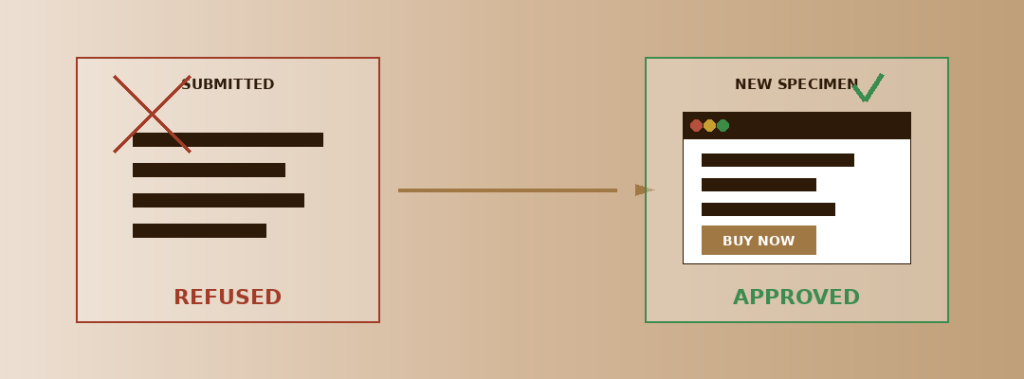
Every trademark application requires a specimen — real-world evidence showing the mark being used in commerce in connection with the goods or services in the application. The USPTO has specific requirements for what constitutes an acceptable specimen, and submitting the wrong type is one of the most common — and most correctable — reasons for refusal.
Common problems include submitting a mockup instead of a live product, providing a website page that doesn’t show an actual means of purchase, or providing a specimen that doesn’t clearly display the applied-for mark.
What to Do: You can submit a substitute specimen showing actual use of the mark in commerce. For product-based marks, this typically means packaging or labeling. For service-based marks, a screenshot of your website displaying the mark alongside a description of the services — with a functional “contact” or “purchase” mechanism — often meets the requirement.
05 — Reason Five Wrong International Class
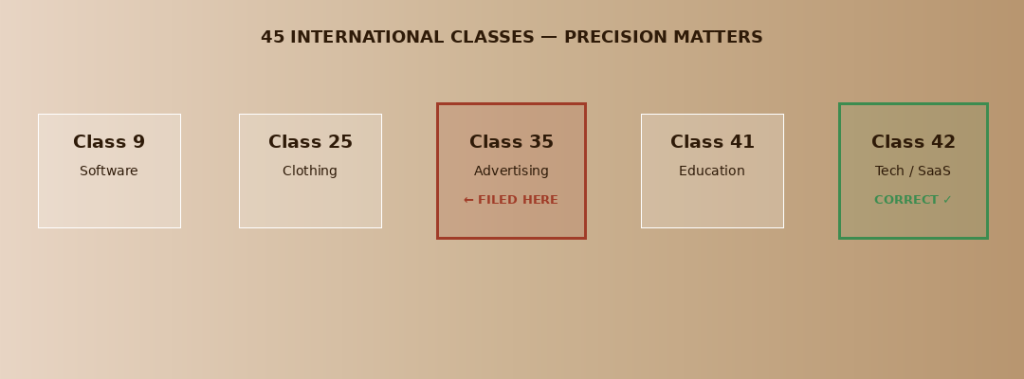
The USPTO’s trademark classification system organizes all goods and services into 45 international classes. Your trademark application must identify the correct class — or classes — that correspond to what you actually offer. Filing in the wrong class means your mark is not protected in the areas that matter to your business.
Many businesses operate across multiple classes — a technology company might need protection in Class 9 (software), Class 42 (SaaS services), and Class 35 (business consulting) simultaneously. Missing a class leaves your brand exposed.
What to Do: An experienced IP attorney will conduct a thorough analysis of your business operations and identify every class in which protection is both available and strategically important. They can amend your identification of goods and services and ensure your mark is registered in every area where it needs coverage.
⚠ You Have 3 Months to Respond.
When the USPTO issues an Office Action, the response deadline begins immediately. You have three months to file a response — with the option to request a single three-month extension for a fee. Miss both deadlines and your application is abandoned, with no refund of your filing fees. The clock does not pause.
A well-crafted Office Action response can turn a rejection into a registered trademark.
Don’t let a USPTO rejection become the end of your brand’s story. Our trademark attorneys review Office Actions, build strategic responses, and fight to get your mark registered.